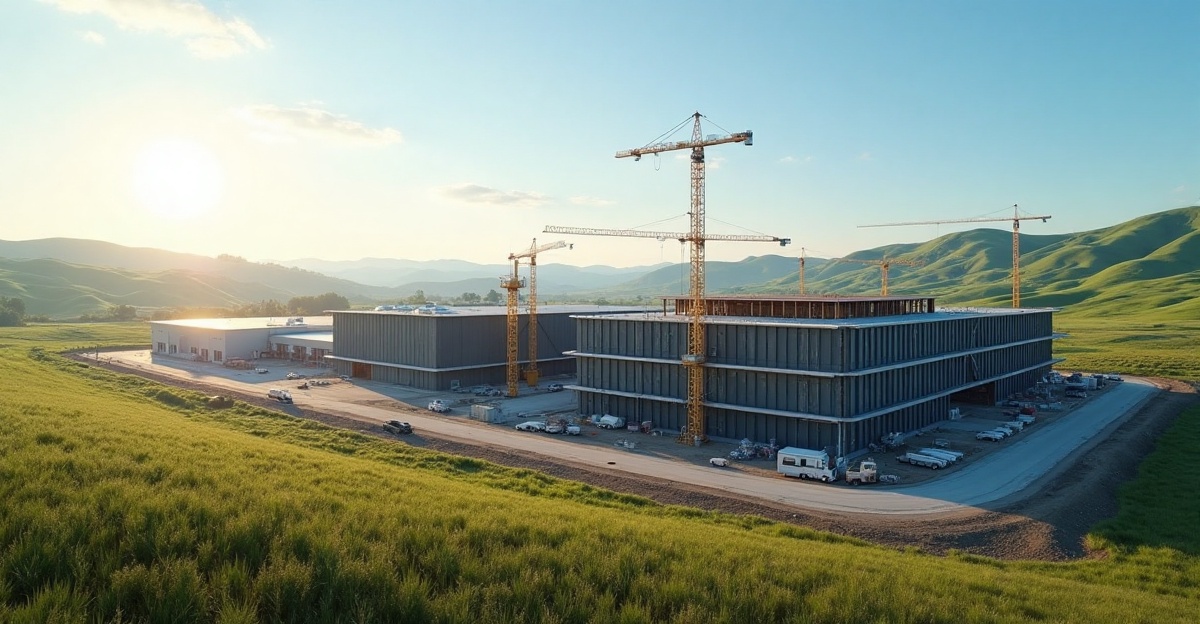
On August 17, 2026, OpenAI announced an agreement for approximately 8 gigawatts of IT capacity at the PORTS-Pike Technology Campus in Pike County, Ohio. The project is being developed in partnership with SB Energy (a subsidiary of SoftBank Group), NVIDIA, and the U.S. Department of Energy on the grounds of the former Portsmouth Gaseous Diffusion Plant, which enriched uranium for the U.S. nuclear weapons program and commercial nuclear reactors from 1954 to 2001.
Project Scope and Timeline
The PORTS-Pike Technology Campus is planned as a six-year construction project through 2032. An initial phase with 800 megawatts of capacity is expected to become operational by 2028, leveraging existing infrastructure from American Electric Power (AEP). The entire campus will be designed for 10 gigawatts of capacity, with 9.2 gigawatts provided by new on-site natural gas power plants. OpenAI will utilize 8 gigawatts of the total capacity.
Jobs and Economic Impact
The project is expected to create approximately 35,000 construction jobs during the six-year construction phase through 2032, followed by 2,500 permanent operating jobs. OpenAI and SB Energy have committed to prioritizing local workforce, contractors, suppliers, and trade businesses.
Financial Commitments and Community Investments
OpenAI has made two separate financial commitments. For a Community Grant Fund, the company is providing $40 million, building on an already-pledged $40 million from SB Energy, for a total of $80 million for community-identified priorities.
Additionally, OpenAI is investing $84 million in Codex Credits via ChatGPT to provide access to technology for more than 844,000 college and tech students in Ohio during the 2026–2027 academic year. SB Energy and the federal government had announced in March 2026 that the investment would be supported by a $550 billion federal program.
Infrastructure and Cost Allocation
OpenAI has committed to covering all project-specific energy and infrastructure costs. SB Energy will assume the full costs of necessary grid upgrades and new transmission lines to supply the data center. The investment is structured so that no costs are shifted to Ohio electricity ratepayers or other regional electricity consumers. According to project participants, the investment should strengthen the regional power grid and support more reliable energy supply in the long term.
Water Management
The data center uses a closed, air-cooled cooling system with water recirculation instead of continuously consumptive cooling towers. Water consumption is expected to be significantly below the historical consumption of the Portsmouth facility. Following cooling system fill-up, ongoing water consumption is estimated to be at the level of an office building with comparable staff size, including sinks, toilets, equipment cleaning, maintenance, and landscaping.
PORTS-Pike is working with the Department of Energy to utilize the existing on-site water system. OpenAI will fund new water infrastructure in partnership with local communities. After completion of site planning, the project will publicly report expected water consumption.
Technology Infrastructure
NVIDIA has secured the role of exclusive provider of AI compute infrastructure at the campus, with OpenAI serving as the customer. The partnership ensures dedicated computing capacity for OpenAI's operations.
Historical Context and Guiding Principles
In the 20th century, Pike County played a central role in U.S. industrial growth through the Portsmouth Gaseous Diffusion Plant. OpenAI is positioning the PORTS-Pike project as a contribution to securing Pike County a leading role in the next era of American industrialization and AI infrastructure development.
As guiding principles for the project, OpenAI has established: assuming all project-specific energy and infrastructure costs, responsible water management through recirculation systems, creating tangible benefits for Pike County and southern Ohio through employment and local business opportunities, and long-term investments shaped by community input.