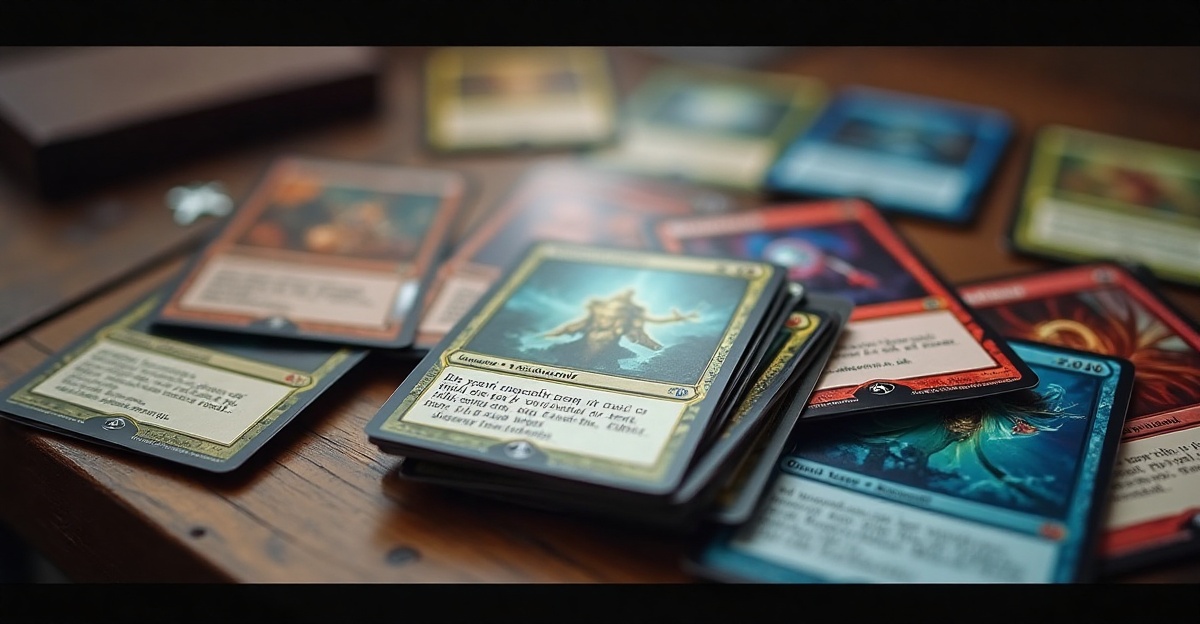
Researchers from Kyoto University presented an encoder-based model on July 6, 2026, that can predict the strength of Magic: The Gathering decks during the drafting process. The work by Tomas Rigaux and Hisashi Kashima addresses a central challenge in AI research for Trading Card Games: the lack of fixed rule structure defined by a large and constantly changing collection of game cards.
Drafting Mode as a Research Domain
In Magic: The Gathering's draft mode, eight players make 39 to 45 sequential card selection decisions to construct a 40-card deck. The mode separates the card selection process from actual gameplay and creates an environment with imperfect information well-suited for machine learning. The complexity lies in the combinatorial synergies between cards and the need to make decisions under uncertainty.
According to the study published on arXiv, the model establishes a first learned benchmark for outcome prediction in MTG draft. The encoder model generates set-contextualized card embeddings and encodes the draft decision sequence. The researchers report measurable improvements over linear baseline methods on large real-world datasets.
Why Magic: The Gathering Complicates Traditional Approaches
Magic: The Gathering publishes thousands of new cards annually, each potentially introducing new mechanics or modifying existing rules. This dynamic rule structure makes traditional policy-learning approaches impractical. Mastery of the game requires continuous adaptation to new content and the ability to encode generic game cards as well as their rule-changing properties.
The research was funded by JST BOOST (JPMJBS2407) and JST CREST (JPMJCR21D1). Code is available on GitHub at github.com/akulen/MtGDraftEncoder. The work builds on early peer-reviewed publications on AI solutions for MTG drafting from 2020 and advances in generalized card representation approaches published in July 2024.
Development of MTG AI Research
In November 2024, a publicly accessible drafting dataset was made available on IEEE DataPort, accelerating research in this area. Kyoto University's current work leverages such datasets to train neural approaches for deck strength prediction. The researchers characterize drafting as a sub-game within the larger Trading Card Game with significant combinatorial complexity and a popular player base on platforms like MTG Arena.
The work demonstrates that encoder architectures are capable of modeling complex interactions between cards without relying on explicit rule engines. This is relevant for generalization to new card sets where manually created heuristics are unavailable.