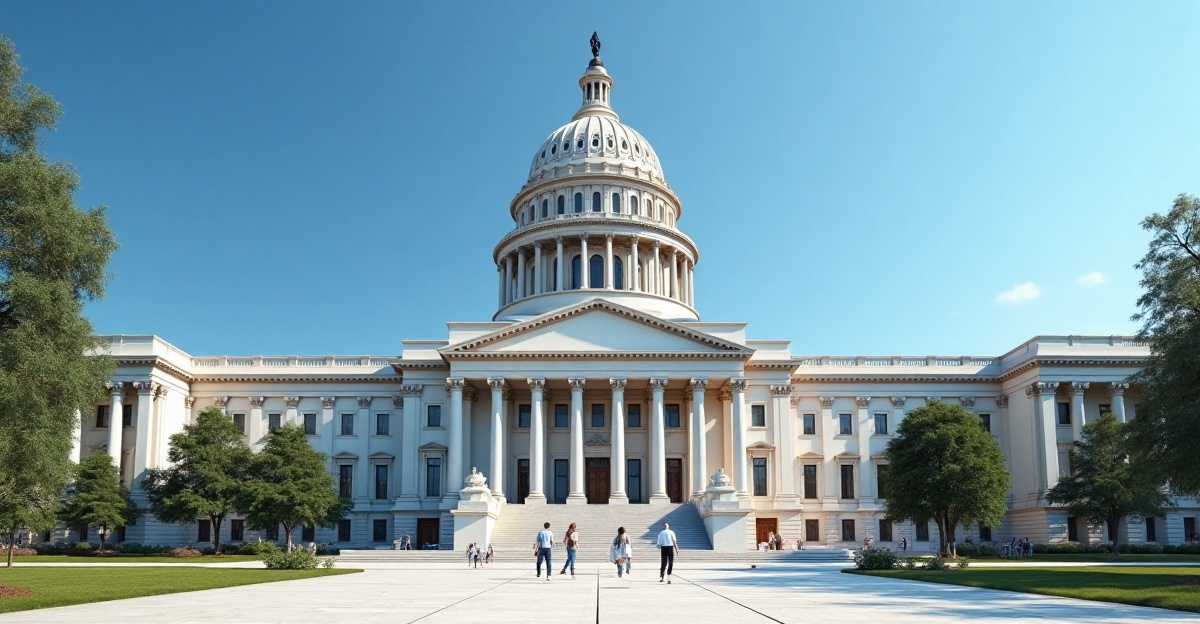
Democratic representatives in the U.S. House of Representatives demanded transparency from OpenAI and Anthropic on August 11, 2026 regarding cybersecurity incidents. In separate letters, lawmakers called for congressional oversight hearings and federal guardrails to prevent future security breaches. The representatives justified their demand by citing the "serious risk that frontier AI models can pose".
The initiative comes during a period of intense debate over how democratic institutions can maintain control over AI systems in security-relevant areas. Parallel to the congressional demand, the Trump administration signed an Executive Order on August 4, 2026 that provides for federal oversight of new advanced models. On August 5, the administration presented a corresponding framework to technology companies, which was presented as part of an "America First Cybersecurity Strategy".
OpenAI Defines Principles for National Security
OpenAI published National Security Principles on July 8, 2026 to govern the use of its technology by governments. The principles emerged through a company-wide process led by national security expert David Kris and included hearings across research, security, policy, and government partnership teams.
The core principles establish that democratic societies should use AI to protect people, defend critical infrastructure, provide public services, and respond to emerging threats—particularly in the area of cyber defense and biological safety. According to OpenAI, AI deployments must strengthen democratic accountability, human judgment, and rule of law. Systems should strengthen democratic institutions rather than concentrate power.
OpenAI's contracts with the U.S. Department of Defense contain explicit restrictions: no use for domestic mass surveillance, no control of autonomous weapons systems, and no automated high-risk decisions. These contractual restrictions were announced in 2026.
International Partnerships and Model Access
In July 2026, OpenAI expanded access to cyber defense tools through its Daybreak program to nine countries and EU institutions. Australia, Canada, Japan, the Republic of Korea, France, Germany, Poland, and the Netherlands received "Trusted Access for Cyber" partnerships. The EU's Cybersecurity Agency ENISA was also included. The United Kingdom maintains a separate trusted partnership for cyber testing and evaluation.
At the same time, OpenAI announced in July expanded access to its GPT-Rosalind model for selected U.S. government and allied partners supporting public health and biodefense.
States as Pioneers of Democratic Oversight
By July 15, 2026, three U.S. states had incorporated democratic oversight into frontier AI regulation. California established the core disclosure framework, New York demonstrated that the approach is transferable across jurisdictions, and Illinois supplemented the framework by requiring independent verification of material disclosures.
OpenAI identified these provisions as essential elements for creating a nationwide standard through "reverse federalism"—the process by which state regulations effectively become national standards.
Federal Security and Governance Initiatives
According to a statement from June 3, 2026, OpenAI advocates for comprehensive federal legislation that builds on the emerging consensus from state frontier security laws. The company calls for strengthening the Center for AI Standards and Innovation (CAISI) as the primary U.S. federal institution for frontier AI security. Additionally, a broader resilience plan should be mobilized across government agencies to address national security and public safety challenges posed by frontier AI.
The Center for Strategic and International Studies (CSIS) announced on August 17, 2026 that its Converging Risks Lab will examine how national security professionals can build institutional capacity in frontier AI security and governance. The project includes fellowship training, exchange with frontier AI labs and security researchers, and public analysis on oversight and maintaining human control as AI capabilities increase.
Open Questions and Transparency Issues
OpenAI acknowledged in its July 2026 statement that "many of the most consequential questions about AI in government, particularly in national security" remain to be answered through democratic processes. The phrasing suggests that fundamental policy questions about democratic oversight mechanisms remain open.
The Brennan Center for Justice separately warned that progress on transparency in government operations is being jeopardized by the Trump administration. The center calls for strengthened congressional oversight and a revision of the Executive Order on classification of secrets.